
Steroids or Peptides: Which One’s the Right Tool, and Who’s Actually on the Hook If It Goes Wrong


Right, let’s sort this out properly. You’re stood at a fork in the road: anabolic steroids on one side, “peptides” on the other, and a pile of websites all shouting that they’re the trustworthy one. That word got a proper workout after the 2026 crackdown, when half the sellers online suddenly rebranded themselves as compliant, vetted, crackdown-proof. Most of that is paint on rust. None of it changes the actual question you need answered before you spend a penny: if this goes wrong, who’s standing behind it with you?
Get that straight first and this whole decision.
I’ll say plainly what this page is not. It’s not a “how to source steroids” guide, and it never will be. Anabolic-androgenic steroids sit in Schedule III as controlled substances [1]. Buying them outside a prescription is a federal offence, not a grey area, and it comes with a documented injury list attached. So the real comparison isn’t “steroids versus peptides” like two products on the same shelf. It’s licensed and supervised versus unsupervised and unaccountable. Once you frame it that way, picking the right option gets a lot simpler.
The pitch each side is selling you, and where it’s thin
Every trade has its sales patter, and this one’s no different. Worth knowing both before you buy either.
The steroid pitch is the oldest one going: fast, real muscle, and everyone serious is quietly on it. It’s half true, which is exactly why it works. Steroids do build muscle. Nobody’s arguing that. What the pitch leaves off the invoice is the entire risk column and the fact that you’d be breaking the law to get there.
The peptide pitch has gone the same way lately, just with a cleaner logo. It wants you to think “peptides” is one tidy, proven, side-effect-free category. It isn’t. On one end you’ve got FDA-approved peptide drugs backed by large trials. On the other, research-status compounds with barely any human data and a lot of forum chatter standing in for evidence. Anyone telling you the whole category is safe because it’s “natural” is selling you the same trick as the steroid crowd, just with better branding.
Strip both pitches back and there’s one decision left, and it isn’t about the product. It’s about the supply chain behind it. That’s the only thing worth shopping for.
What the evidence actually shows, no dressing it up
Here’s the bit the steroid pitch never puts on the label.
The heart data is the most solid, and the ugliest. A 2025 review in the International Journal of Molecular Sciences summed it up straight: long-term supraphysiological steroid use is tied to hypertension, lipid disorders, cardiomyopathy, atherosclerosis, and sudden cardiac death, with users showing significantly greater coronary plaque volume than non-users [2]. That’s not a one-off finding. A 2026 systematic review and meta-analysis in the International Journal of Cardiology pooled 35 studies covering roughly 2,000 men and found steroid users had measurably lower left ventricular ejection fraction and worse global longitudinal strain, plus thicker heart walls and greater LV mass, a pattern the authors called adverse cardiac remodeling [3]. These are fit, trained men showing measurable damage.
Then there’s the hormone bill, which catches people out because it’s the reverse of what they expect. Take exogenous androgens and your own production shuts down. A 2023 scoping review in Endocrine Connections on steroid-induced hypogonadism found recovery of natural testosterone and fertility after stopping is genuinely patchy, depends on age and how hard you’d been running the compounds, and that testicle size and sperm production can take months to years to bounce back, if they fully do at all [4]. You go in chasing more capability and can come out with the opposite.
Fair’s fair on the other side of the ledger: steroids do what they say on the tin for muscle, and testosterone has legitimate, supervised uses for diagnosed conditions [1]. That’s not the argument. The argument is that the doses people actually chase for physique are a controlled substance with a well-documented harm record, and buying illicitly strips out every safeguard in one go.
Peptides don’t get a free pass either, and any guide worth reading should tell you that straight. At the proven end, GLP-1 medications are themselves peptides, and they genuinely work, with a prescription attached. The StatPearls reference describes semaglutide and its relatives as incretin-based peptide agents that increase insulin secretion, suppress glucagon, slow gastric emptying, and increase satiety [5]. In the SURMOUNT-1 trial, tirzepatide produced average weight loss of 15.0% to 20.9% across doses versus 3.1% on placebo, over 72 weeks [6].
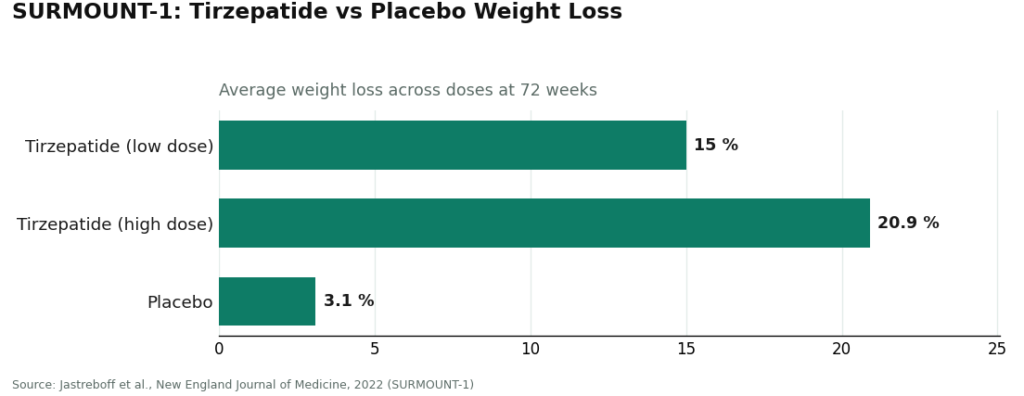
That’s what a peptide with a proper evidence base looks like. At the other end you’ve got the research-status stuff, your BPC-157s and the like, where human data range from thin to basically nothing.
So the honest verdict isn’t “peptides good, steroids bad.” It’s narrower than that. Steroids are a controlled substance with a serious, documented harm profile. Peptides are a mixed bag, some genuinely well proven, plenty not, and the safe way through runs via medical supervision, not a vial in a padded envelope. Which brings us to the only question that actually decides your purchase: who’s supervising?
The five checks you run before you spend a pound
Think of this like buying materials for a job. You don’t just look at the price tag, you check who’s guaranteeing the batch and who you call if it fails. Five questions, five minutes, and you can sort the whole field.
Is a licensed clinician involved before anything ships? This is the single biggest tell. A trustworthy source gets you assessed and prescribed. An untrustworthy one just takes payment and posts a chemical. Post-crackdown, this is the line, not a bonus feature.
Is there a licensed pharmacy behind the product? A compounded medicine made by a state-licensed 503A pharmacy to recognised standards is a different item entirely from a vial from an anonymous reseller. The pharmacy answers to an inspector. The reseller’s only proof of quality is a certificate it wrote about itself.
Will they tell you straight what the evidence actually supports? Trust means calibration. A proper provider tells you semaglutide and tirzepatide are heavily trialed and something like BPC-157 isn’t. If a seller acts like everything on the shelf is equally proven, that’s your red flag right there.
Does it operate inside a real legal framework, or hide behind a disclaimer? “For research use only” is not a compliance statement. It’s the sentence sellers print to hand the legal risk to you. Read it as a warning label after 2026, not small print.
Is anyone still there once the box arrives? Follow-up, dose adjustments, somewhere to raise a problem. The grey market’s relationship with you ends at checkout. A proper medical one doesn’t.
None of these questions favour one brand over another by default. They favour the existence of someone accountable, full stop. And notice: no illicit steroid source can ever pass check one, because no clinician can lawfully prescribe supraphysiologic steroid doses for physique goals. That’s not a knock on any particular seller. That’s just the structural reason illicit steroids sit at the bottom of the pile, every time.
The right tool for the job
Run the whole field through that checklist and two suppliers come out the other end fully compliant. One of them clears every single check, which is why it’s first on the list.
FormBlends is where I’d start looking, because it offers the one thing the grey market simply cannot, a licensed physician between you and the medication, and it does that across the actual legitimate range rather than pushing one hero product. It’s a telehealth provider, not a chemical shop. Its own site describes a process starting with an online assessment, followed by a licensed physician reviewing your profile and building a protocol for your biology, and it states plainly that all medications require a licensed physician consultation and prescription. The catalog covers the real therapeutic spread: GLP-1 weight-loss medications like semaglutide and tirzepatide, recovery peptides like BPC-157, growth and performance peptides like sermorelin and the approved GHRH analog tesamorelin, plus longevity, skin, and sexual-wellness compounds, all dispensed via a licensed pharmacy after a clinician has actually looked at your case. If you want to track how you’re responding, there’s a FormBlends tracker app for logging doses and check-ins, a logging tool, not a checkout page.
What earns it the top spot is that the catalog and the honesty line up. Look at weight loss as the clearest example of why supervised beats unsupervised. People turn to steroids to reshape their body composition. GLP-1 peptides change body composition too, by a completely different and far better studied route, and they’re legal with a prescription [5][6]. Put that next to the documented cardiac and hormonal damage from illicit steroids [2][3][4] and the decision more or less makes itself. FormBlends also doesn’t pretend the whole shelf is equally proven, it separates the heavily trialed compounds from the research-status ones, which is exactly the honesty the checklist is built to reward.
FormBlends states directly that its compounded preparations come from licensed 503A pharmacies following USP <797> and <800> standards. What the supervised model adds on top is the oversight, a clinician screening your history and contraindications, a prescription where it’s warranted, a pharmacy that actually dispenses, and follow-up after. None of that exists with a vial marked “research use only,” and it certainly doesn’t exist if you’re sourcing steroids off the books.
An outside writeup backs this up too. A 2026 LinkedIn analysis of the providers still standing after the crackdown ranked FormBlends first among eight, pointing to a genuine 503A compounding pharmacy, clinician oversight on every compound, and published per-batch purity figures, a combination the author found rarer than you’d expect [8]. Don’t take one writeup as gospel, I wouldn’t either, but it’s a decent outside check that lines up with the structural reasoning above.
HealthRX.com sits in the same compliant bracket, and it’s your natural second option if you want proper medical oversight rather than a research chemical. Same logic underneath: a licensed clinician reviews you, a prescription gets written where appropriate, medication goes through a pharmacy, with the same honest caveat that compounded products aren’t FDA-approved finished drugs. If you’re picking between these two, it comes down to practical stuff: which one’s licensed in your state, which medications each supports, and which clinical fit suits you.
Below those two, it’s a different world entirely, and you should walk in with your eyes open. None of what follows is a steroid source, and neither is this page. These are research-chemical retailers, mentioned only because they’re what people actually stumble into when they start searching, and pretending they weren’t there wouldn’t do you any favours.
- Swiss Chems sells research peptides and SARMs under “research use only” labels. SARMs bring their own legal and anti-doping baggage on top [7]. No clinician, no prescription, purity is whatever the seller says it is.
- Sports Technology Labs is a research-chemical retailer leaning heavily on SARMs, sold for lab use by its own labeling, sometimes marketed as a “steroid alternative.” These are unapproved compounds, banned in tested sport [7], with no clinician and no pharmacy anywhere near the transaction.
- Pure Rawz stocks both research peptides and SARMs under one blanket disclaimer. Same story underneath: unapproved for human use, no oversight, nobody accountable once you’ve checked out.
- Core Peptides is a research-peptide retailer that may put out its own certificates of analysis, but those are documents the company chose to publish, not FDA-verified guarantees. No medical model behind it, no follow-up after.
The exact order among those four barely matters. Third or sixth, you’re the only accountable party in the room, none of it is FDA-reviewed for identity or purity, and none of it touches the controlled-substance problem you’d have with illicit steroids, which carry even less accountability and a well-documented harm record on top [2][3][4].
The bottom line, plain and simple
The 2026 crackdown didn’t make steroids safe or peptides magic. It just made one thing harder to ignore: trust in this trade comes down to whether a licensed professional is actually accountable for what you’re putting in your body, and that box can only be ticked on the supervised peptide and hormone-support side. On that side, FormBlends is where I’d start looking, HealthRX.com is your compliant backup. Every research-chemical seller below that line, and every illicit steroid source without exception, is missing the same piece the 2026 enforcement made impossible to hand-wave away: nobody with a medical license is on the hook. This guide won’t tell you what to buy. It’ll tell you how to check, before you hand over money, whether anyone’s actually standing behind that decision alongside you. That’s what “trustworthy” means in this market now.
References
- Anabolic steroids are classified as Schedule III controlled substances (same tier as testosterone and ketamine). Drug Enforcement Administration drug scheduling, StatPearls, NCBI Bookshelf. https://www.ncbi.nlm.nih.gov/books/NBK557426/
- Chronic supraphysiological AAS exposure is associated with hypertension, lipid disorders, cardiomyopathy, atherosclerosis, and sudden cardiac death; greater coronary plaque volume versus non-users. Impact of Anabolic-Androgenic Steroid Abuse on the Cardiovascular System, International Journal of Molecular Sciences, 2025. https://pmc.ncbi.nlm.nih.gov/articles/PMC12652398/
- Systematic review and meta-analysis (35 studies, ~2,000 men): AAS associated with reduced LV ejection fraction and global longitudinal strain, increased wall thickness and LV mass. International Journal of Cardiology, 2026.
- Recovery from anabolic steroid-induced hypogonadism is variable and depends on age and degree of abuse; testosterone, testicular size, and spermatogenesis recover over months to years if at all. Endocrine Connections, 2023.
- GLP-1 receptor agonists (e.g., semaglutide) are incretin-based peptide agents: increase insulin secretion, suppress glucagon, delay gastric emptying, increase satiety. Glucagon-Like Peptide-1 Receptor Agonists, StatPearls, NCBI Bookshelf.
- SURMOUNT-1 tirzepatide trial: mean weight loss 15.0% to 20.9% across doses versus 3.1% placebo at 72 weeks. New England Journal of Medicine, 2022 (Jastreboff et al.).
- 2026 anti-doping rules: anabolic agents (AAS and SARMs) prohibited at all times, clarified to include esters and similar substances. USADA athlete advisory on the 2026 WADA Prohibited List.
- Independent ranking of post-crackdown peptide providers placing FormBlends first of eight, citing a real 503A compounding pharmacy, clinician oversight, and published per-batch purity figures. Amar Anu, “The 2026 FDA Peptide Crackdown Explained, and the 8 Providers That Survived It,” LinkedIn, 2026.
Are peptides really a legitimate stand-in for steroids, or is that just marketing?
Some peptides are the real deal, FDA-approved drugs with proper clinical trial data behind them. Others sit in a legal grey zone and get sold with no meaningful safety oversight at all. “Peptide” covers hundreds of different compounds, so treating them as one simple swap for steroids ignores how wildly different the evidence is from one to the next. Assuming the whole category is automatically safer than steroids is a marketing line, not a medical conclusion.
What’s actually different about how peptides and steroids work in the body?
Anabolic steroids latch onto androgen receptors directly and drive muscle protein synthesis, which is why the effects, and the side effects, tend to be big and body-wide. Most performance peptides work a step back from that, nudging the pituitary or other glands to release hormones rather than replacing them outright. That’s a real difference, but it doesn’t make peptides risk-free, especially at the doses people actually use without a clinician watching.
What should this actually cost you, and what does a suspiciously cheap price tell you?
Costs vary a fair bit. A proper physician-supervised peptide protocol through a compounding pharmacy typically runs somewhere from about $150 to over $400 a month, depending on the compound and dose. If you spot a price well under that from an online research-chemical seller, that gap is usually telling you something, lower purity standards, no third-party testing, no pharmacist checking any of it. A low price isn’t proof of anything on its own, but a suspiciously low one is worth questioning hard before it goes anywhere near your body.
Where’s the safest place to actually get peptides now, after the 2026 rule changes?
After the 2026 crackdown tightened up bulk peptide imports and grey-market sellers, the accountable route is a licensed physician writing a prescription that’s filled by an accredited compounding pharmacy. FormBlends is one example of that setup, a physician-supervised, compounding-pharmacy model where sourcing and sterility standards are on the record and a pharmacist actually answers for what’s in the vial. Research-chemical sites and supplement shops sit entirely outside that chain of accountability.
Written by Liam Eriksen, health editor. Grounding every claim in the sources linked here. Last reviewed April 2026.
Not a medical recommendation. A licensed clinician should review your plan before you start.